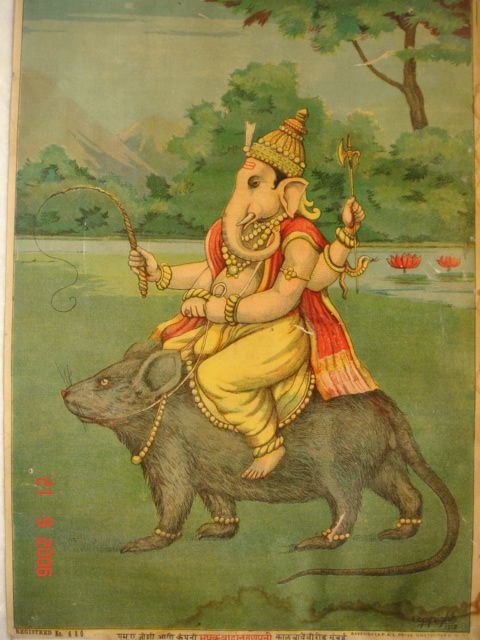
"Om Gan Ganpataye Namo Namah"
Every diya you light here is complete, just as it is. Sharing or supporting Daily Darshan simply helps this quiet space reach more people — never required, always felt. 🙏
Tap once for each repetition of the mantra. A full mala is 108 chants — your count is saved on this device and renews with each new day.
Ganesha is the elephant-headed son of Shiva and Parvati, and the first deity invoked before any new undertaking — a wedding, a new home, a business, the first page of an account book. He is known as Vighnaharta, the remover of obstacles, and also as the one who can place obstacles in the path of those who act without wisdom.
Ganesha's broken tusk, his large ears, and his small mouse companion Mushika are each read by devotees as teachings: to listen more than you speak, to use what breaks you as a tool rather than a wound, and to stay humble no matter how large your form.
The Origin of Ganesha
The most beloved story of Ganesha's birth begins with Parvati, who fashioned a boy from turmeric paste and the oils of her own body and breathed life into him, setting him to guard her door while she bathed. When Shiva returned and the child refused him entry, Shiva in his fury severed the boy's head. Parvati's grief was immeasurable. To restore her son, Shiva sent his ganas (attendants) to bring the head of the first creature found sleeping with its head facing north — they returned with an elephant's head, and Shiva placed it on the boy's body, restoring his life and declaring him the foremost among the gods, to be worshipped before all others.
Versions of this story vary across the Puranas, but the heart of each telling is the same: Ganesha's form — unusual, hybrid, requiring explanation — is itself a teaching. The sacred does not always arrive in the expected shape. The obstacles we face carry within them the possibility of unexpected wisdom.
Symbols and What They Mean
Every element of Ganesha's iconography is a carefully layered teaching. The elephant head represents supreme wisdom and the power of discrimination — the ability to perceive what is real beneath appearances. The large ears hear everything; the small mouth speaks sparingly. The trunk, which can uproot a tree and pick up a needle with equal ease, represents adaptability and the capacity to handle tasks of any scale.
The broken tusk has several explanations in different texts. In one, Ganesha broke it off to use as a pen when scribing the Mahabharata at Vyasa's dictation, agreeing to write without stopping only if Vyasa agreed to compose without pause. The mouse Mushika, Ganesha's vahana (vehicle), represents the mind — restless, quick, capable of gnawing through every obstacle — tamed and ridden by wisdom. That the vast Ganesha rides such a small creature is the teaching itself: the great is carried by what appears small when properly understood.
Ganesh Chaturthi
Ganesh Chaturthi, the festival celebrating Ganesha's birthday, falls on the fourth day of the bright fortnight in the month of Bhadrapada (August or September). It is among the most widely celebrated festivals in India, with its greatest expression in Maharashtra, where elaborate clay idols are installed in homes and public spaces, celebrated with music, prayers, and community feasting for ten days, and then carried in joyful procession to a river or the sea for immersion. The immersion, called Visarjan, is not a farewell but a teaching: the beloved form dissolves back into the water from which it came, and in letting go, something is understood about the nature of all form.
Ganesha as Patron of Beginnings and Arts
Ganesha is the patron of writers, students, and those who work with language and knowledge. In classical Sanskrit texts, authors traditionally open with an invocation to Ganesha, acknowledging that any work of intelligence and craft begins not with the author's cleverness but with the grace of the one who clears the path. Business ledgers traditionally bore his image on the first page. Students place his image near their books before an examination. Wednesday is his sacred day, and his seed mantra, Om Gan Ganpataye Namo Namah, is considered among the most accessible and powerful for daily use.
Lord Hanuman · Lord Shiva · Goddess Lakshmi · Lord Krishna · Goddess Durga · Goddess Saraswati · Lord Rama · Sai Baba