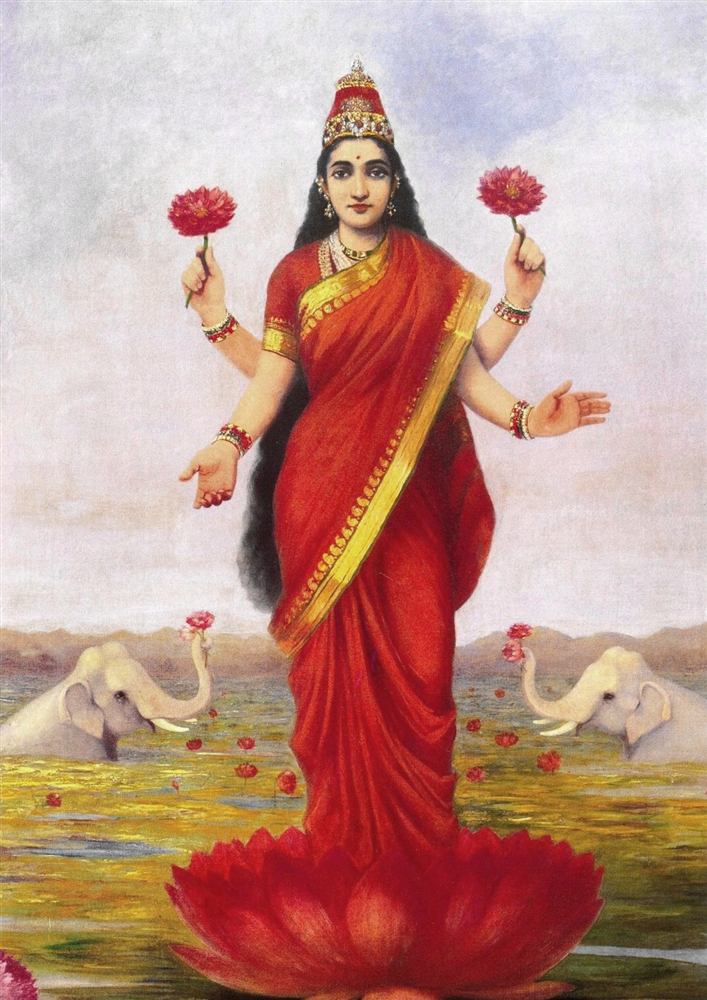
"Om Shreem Mahalakshmiyei Namaha"
Every diya you light here is complete, just as it is. Sharing or supporting Daily Darshan simply helps this quiet space reach more people — never required, always felt. 🙏
Tap once for each repetition of the mantra. A full mala is 108 chants — your count is saved on this device and renews with each new day.
Lakshmi is the goddess of wealth, fortune, and prosperity — understood not only as material abundance but as wellbeing in every form: health, happiness, generosity, and grace. She is the consort of Lord Vishnu, traditionally depicted seated on a blooming lotus, with gold coins flowing from her open palms.
Devotees light lamps for Lakshmi each evening, particularly at dusk, when she is said to enter homes that are clean, welcoming, and lit. Her presence is most widely celebrated during Diwali, the festival of lights.
The Origin and Nature of Lakshmi
Lakshmi emerged from the churning of the cosmic ocean — the Samudra Manthan — in which gods and demons cooperated to churn the primordial waters in search of the nectar of immortality. From the depths rose many treasures, and among them came Lakshmi herself, seated on a lotus, radiant and fully formed, choosing Vishnu as her eternal consort. This origin story places Lakshmi at the intersection of cosmic effort, cooperation, and divine grace: abundance does not come from force alone, but from patient, sustained effort in alignment with dharma, and from an openness to receive what emerges.
Lakshmi is understood as Vishnu's Shakti — his divine energy and power of manifestation. Where Vishnu represents the preserving, sustaining principle of the universe, Lakshmi is the abundance and grace through which that sustenance expresses itself in the world. In many traditions, prayers to Vishnu are offered as prayers to Lakshmi-Narayana together.
The Ashta Lakshmi — Eight Forms of Abundance
Lakshmi is not a single, narrow goddess of money. The tradition of the Ashta Lakshmi — the eight Lakshmis — makes explicit what is implicit in every prayer to her: that abundance takes many forms, and each deserves to be cultivated and honoured.
Adi Lakshmi is the primordial form, Lakshmi as pure divine grace. Dhana Lakshmi presides over material wealth and financial prosperity. Dhanya Lakshmi governs grain, nourishment, and agricultural abundance. Gaja Lakshmi — Lakshmi flanked by elephants — represents royal prosperity and dignity. Santana Lakshmi blesses families with children and the continuation of lineage. Veera Lakshmi grants courage and strength in difficulty. Vidya Lakshmi bestows knowledge and the wealth of learning. Vijaya Lakshmi grants victory and success in righteous endeavours. To pray to Lakshmi is to open oneself to all of these — not just a full bank account, but a full life.
Diwali and the Lamp at Dusk
Diwali, the festival of lights, is the most widely celebrated occasion for Lakshmi's worship. On the new moon of the month of Kartika (October or November), households across India and the Hindu diaspora are cleaned thoroughly, decorated with rangoli (coloured powder patterns), and lit with rows of clay diyas. The darkness of the new moon is precisely the point — Lakshmi is said to visit the homes that shine most brightly in the dark, drawn by the warmth of the welcome.
The tradition of lighting a lamp for Lakshmi at dusk every evening reflects a simpler teaching: that welcoming abundance is a daily practice, not an annual event. A clean, lit, welcoming home is understood as a home that Lakshmi can enter. The lamp is both a symbol and an invitation.
Lakshmi's Iconography
Lakshmi is almost always depicted in gold and red — gold for abundance and the divine, red for auspiciousness and the energy of life. The lotus she sits upon is understood as a symbol of purity: the lotus grows from muddy water but is untouched by it, just as true prosperity does not depend on circumstances and is not corrupted by contact with the world. The coins that flow from her hands are given freely, without grasping — an image of abundance that circulates rather than hoards. Friday is her sacred day, and her seed mantra, Om Shreem Mahalakshmiyei Namaha, is considered especially powerful when chanted on Fridays or during the waxing phase of the moon.
Lord Hanuman · Lord Shiva · Lord Ganesha · Lord Krishna · Goddess Durga · Goddess Saraswati · Lord Rama · Sai Baba