"Om Tryambakam Yajamahe Sugandhim Pushtivardhanam"
Every diya you light here is complete, just as it is. Sharing or supporting Daily Darshan simply helps this quiet space reach more people — never required, always felt. 🙏
Tap once for each repetition of the mantra. A full mala is 108 chants — your count is saved on this device and renews with each new day.
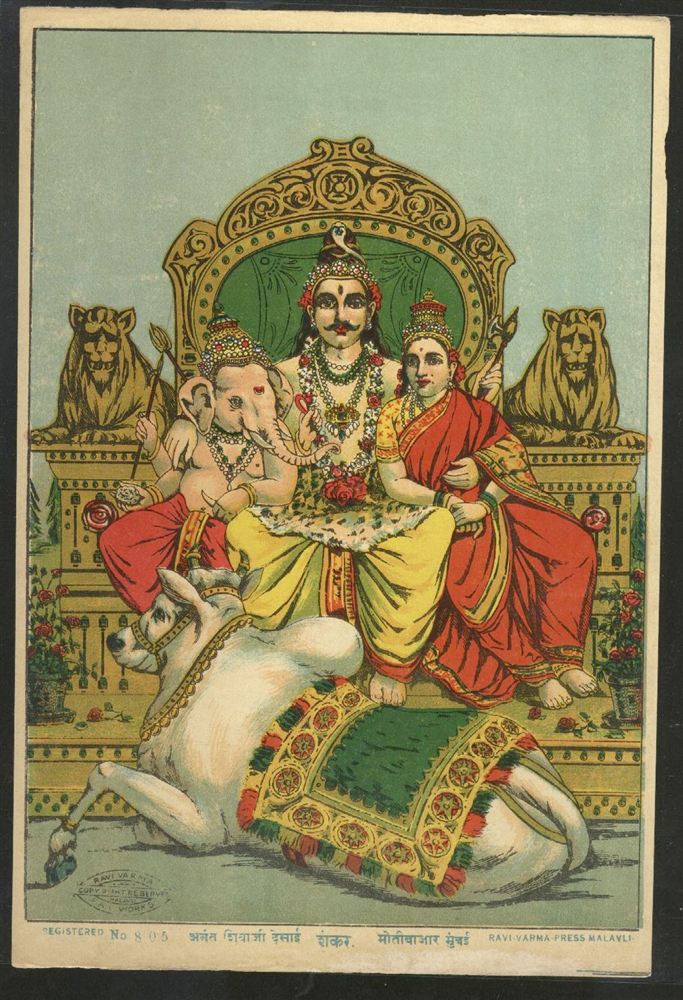
Shiva is one of the three principal forms of the divine in Hinduism, embodying destruction not as violence but as the clearing away of what is outworn so that renewal becomes possible. He is Mahadev, the great god, often depicted in deep meditation atop Mount Kailash, with the crescent moon in his hair and the sacred Ganga flowing from his head.
Shiva is approached for inner stillness, for release from fear — including the fear of death — and for the courage to let go of what no longer serves. Mondays are traditionally observed as days of Shiva worship, and Maha Shivaratri, "the great night of Shiva," is among the most significant festivals dedicated to him.
The Nature of Shiva
Unlike many deities whose stories unfold primarily in domestic or courtly settings, Shiva's domain is the wilderness, the cremation ground, and the deep mountain silence. He is the god who dwells at the edges: ash-smeared, matted-haired, accompanied by ghosts and outcasts, the one to whom those who have nowhere else to turn can always come. In this sense, Shiva represents the understanding that the divine is not found only in beautiful, orderly, comfortable places — it is equally present in endings, in loss, in the bare ground of grief.
At the same time, Shiva is the supreme householder — his marriage to Parvati, the mountain goddess who won him through years of austere devotion, is one of the great love stories of Hindu mythology. Their son Ganesha is worshipped before every undertaking. Their son Kartikeya is the god of war and righteous battle. Shiva holds within himself the entire range of human experience: ascetic and husband, destroyer and nurturer, terrifying and deeply tender.
The Linga and Its Meaning
Shiva is most commonly worshipped through the Shivalinga, a cylindrical stone form that represents the formless, infinite dimension of the divine — what cannot be depicted as a face or a body. The linga rests within a yoni (the base), understood as the union of consciousness and energy, Shiva and Shakti, from which all creation arises. Devotees pour water, milk, honey, and bilva leaves over the linga in a ritual called abhisheka, an act of cooling the fierce energy of the god and receiving his blessings in return.
Om Namah Shivaya and the Mahamrityunjaya Mantra
Om Namah Shivaya — "I bow to Shiva" — is one of the oldest mantras in continuous use in human history, appearing in the Krishna Yajurveda. Its five syllables Na, Ma, Shi, Va, Ya correspond to the five elements: earth, water, fire, air, and space. Chanting this mantra is understood as an alignment of the self with the structure of existence itself.
The Mahamrityunjaya Mantra — the great death-conquering mantra — is addressed to Shiva as Tryambaka, the three-eyed one. It is chanted for health, longevity, and protection from premature death, and is considered one of the most powerful mantras in the Vedic tradition. Hospitals, homes of the sick, and places of mourning often resound with its syllables as a reminder that consciousness does not end at the body's edge.
Maha Shivaratri
Maha Shivaratri falls on the fourteenth night of the dark fortnight in the month of Phalguna (February or March). Devotees observe a fast, stay awake through the night, and offer prayers every three hours in a vigil of devotion. The night of Shivaratri is considered especially auspicious for meditation — the planetary alignment is said to support an upward movement of energy in the spine, making the night naturally conducive to inner stillness. In the great temples of Varanasi, Ujjain, and Somnath, hundreds of thousands gather to witness the abhisheka of the linga and to carry their own small diyas through the night.
Why Devotees Light a Diya for Shiva
Shiva holds fire as both symbol and tool: the damaru drum he holds creates the universe with its rhythm, and the flame in his other hand dissolves it again. To light a diya for Shiva is to participate in this eternal cycle — to acknowledge that what has served its purpose can be released, and that in the clearing, something truer becomes possible. Many devotees find in Shiva's worship a permission to let go: of fear, of grief, of identities that have grown too tight.
Lord Hanuman · Lord Ganesha · Goddess Lakshmi · Lord Krishna · Goddess Durga · Goddess Saraswati · Lord Rama · Sai Baba