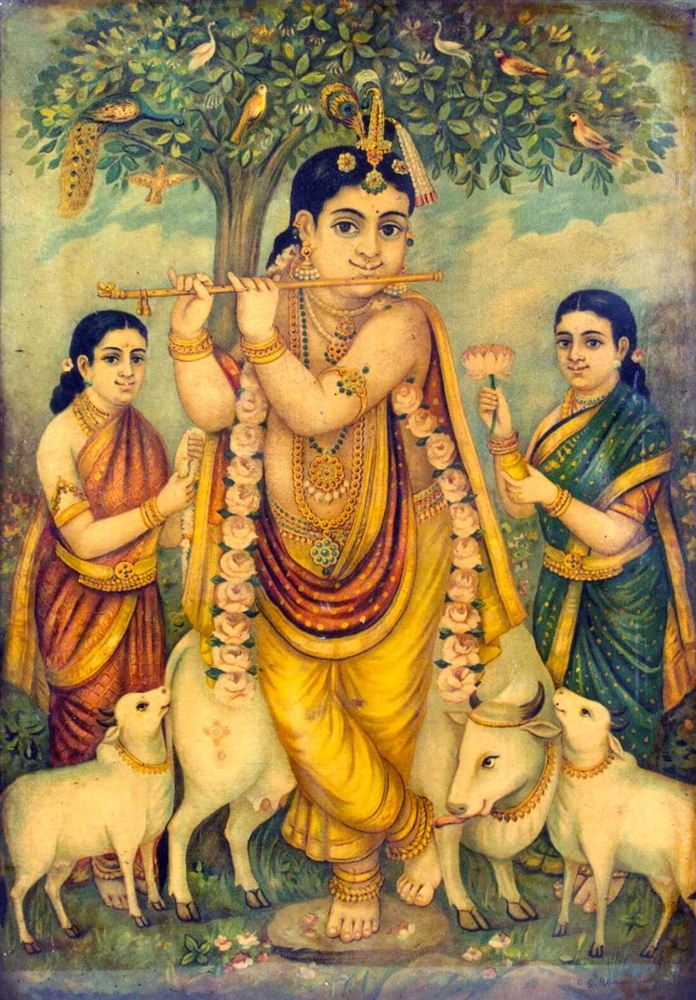
"Hare Krishna Hare Krishna, Krishna Krishna Hare Hare"
Every diya you light here is complete, just as it is. Sharing or supporting Daily Darshan simply helps this quiet space reach more people — never required, always felt. 🙏
Tap once for each repetition of the mantra. A full mala is 108 chants — your count is saved on this device and renews with each new day.
Krishna is worshipped as the eighth avatar of Vishnu, and by many devotees as the Supreme Lord in his own right. He is remembered both as the playful, flute-playing cowherd of Vrindavan and as the composed charioteer-philosopher who delivered the Bhagavad Gita — one of the most translated and widely read spiritual texts in the world.
Krishna's teaching centres on duty without attachment to outcome, devotion as a path open to everyone regardless of background, and the idea that the divine can be approached through love as readily as through ritual.
The Life of Krishna
Krishna was born in Mathura to Devaki and Vasudeva at midnight, on the eighth day of the dark fortnight of the month of Bhadrapada. His birth itself was an act of cosmic necessity: the demon king Kamsa had been told by a prophecy that Devaki's eighth child would destroy him. He imprisoned Devaki and Vasudeva and killed each child as it was born. When Krishna arrived, the prison doors opened on their own, the guards fell into a deep sleep, and Vasudeva carried the infant across the flooded Yamuna river to the safety of Gokul, where he was raised by the cowherd foster parents Nanda and Yashoda.
Krishna's childhood in Vrindavan is among the most beloved passages of Hindu sacred literature. He stole butter from the neighbours' clay pots, enchanted the gopis with his flute playing, defeated the serpent Kaliya in the river, and lifted the entire Govardhan mountain on his little finger to shelter the village from seven days of rain sent by Indra. These stories carry a teaching about the divine's relationship to the world: intimate, playful, present in the ordinary, capable of the extraordinary without strain or drama.
The Bhagavad Gita
When the great war of the Mahabharata reached its moment of crisis and the warrior Arjuna stood between the two armies, unable to raise his bow against his own kin, it was Krishna who spoke. Over the course of eighteen chapters — the Bhagavad Gita, the Song of God — Krishna addressed every dimension of Arjuna's paralysis: fear of death, attachment to outcome, confusion about duty, and the nature of the self that persists through all of it.
The Gita teaches karma yoga — performing one's duty fully, without attachment to the fruits of the action. It teaches bhakti yoga — devotion as the most accessible path to liberation, available to the scholar and the unlettered alike. And it teaches that the self (atman) is not the body or the personality, but the witnessing consciousness that does not die when the body does. All these paths, rightly understood, lead to the same destination.
Krishna as Divine Love
The relationship between Krishna and the gopis of Vrindavan — and especially the gopi Radha — is understood in the Vaishnava traditions as the supreme model of devotional love. The gopis abandoned everything to run toward Krishna when they heard his flute at night. This abandonment is not irresponsibility but the highest form of surrender: the self giving itself entirely to the divine, holding nothing back.
Radha represents the soul in its most complete orientation toward the divine: entirely absorbed, entirely given over, finding in that giving not a loss of self but its fullest possible expression. The image of Radha-Krishna together is the image of the soul and God as not truly separate — love as the nature of reality itself.
Janmashtami and the Hare Krishna Mantra
Krishna's birth is celebrated each year at Janmashtami, on the eighth day of the dark fortnight of Bhadrapada. Devotees fast through the day and gather at midnight for prayers, bhajans (devotional songs), and the ceremonial rocking of a cradle containing an image of the infant Krishna. In Maharashtra, the festival also features Dahi Handi, in which young men form human pyramids to break a pot of curd hung high — a re-enactment of young Krishna's famous butter thefts.
The Hare Krishna maha-mantra — Hare Krishna Hare Krishna, Krishna Krishna Hare Hare, Hare Rama Hare Rama, Rama Rama Hare Hare — is considered the great mantra for this age in the Gaudiya Vaishnava tradition. The mantra's sixteen names are understood not as a description of God but as a direct call to the divine — an invitation to presence. Wednesday and Thursday are considered auspicious for Krishna's worship, and his temples from Vrindavan and Mathura to Udupi and Dwarka are among the most visited in India.
Lord Hanuman · Lord Shiva · Lord Ganesha · Goddess Lakshmi · Goddess Durga · Goddess Saraswati · Lord Rama · Sai Baba